DIY note
History of the Phonograph
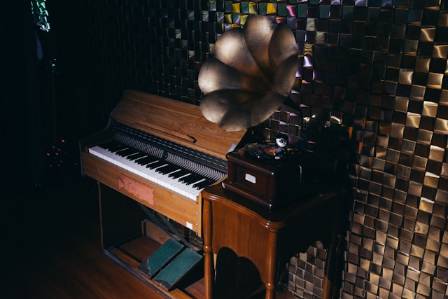
The history of turntables and record players is closely connected to a long series of technological breakthroughs. Over the years, new mechanisms, materials, and designs have steadily improved the way recorded sound is captured and reproduced. Although today's record players look very different from the earliest machines, many of their fundamental ideas can be traced back to the original development of the phonograph.
Stella Collins
Maker
Bench tip
Read the full note below and keep tools nearby.
Shelf
Hobby build
The history of turntables and record players is closely connected to a long series of technological breakthroughs. Over the years, new mechanisms, materials, and designs have steadily improved the way recorded sound is captured and reproduced. Although today's record players look very different from the earliest machines, many of their fundamental ideas can be traced back to the original development of the phonograph.
Early History
The earliest known predecessor of the phonograph was created and patented by Édouard-Léon Scott in 1857. He named his invention the phonautograph and officially patented it on March 25 of that year.
Scott's machine was designed to capture sound waves rather than reproduce them. It traced vibrations onto a glass surface, allowing researchers to study the characteristics of sound, but it had no mechanism for playing those recordings back. Its primary purpose was the scientific examination of acoustics rather than entertainment or music playback.
The design was later adapted to record sound patterns onto lampblack-covered paper wrapped around a rotating drum or cylinder. Although the phonautograph could not reproduce what it recorded, it became an important foundation for later sound-recording technologies and helped inspire the invention of the phonograph.
Thomas Edison's Phonograph
Thomas Edison introduced his phonograph in 1877, drawing upon concepts associated with the phonautograph as well as developments in the telegraph and telephone.
His original objective was to create a machine capable of transcribing telegraph messages onto paper tape. The idea was that a recorded message could then be reproduced and transmitted repeatedly through telegraph equipment.
After recognizing that the same principles could potentially be applied to telephone communications, Edison began experimenting with methods for capturing and reproducing sound. His resulting machine used one needle to etch sound vibrations onto a tin-foil-covered cylinder. A second needle could then trace the recording and reproduce the captured sound.
Working with John Kruesi to construct the machine, Edison famously recorded the nursery rhyme "Mary Had a Little Lamb" and successfully played it back. This demonstration proved that recorded sound could be reproduced mechanically.
Edison submitted his phonograph patent application on December 24, 1877. The patent was subsequently granted on February 19, 1878.
Recording and Reproducing Sound
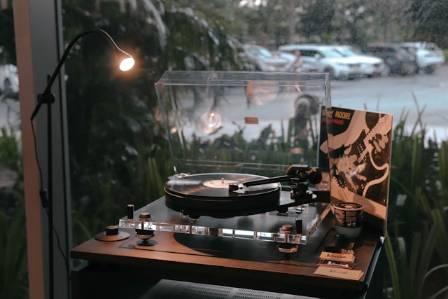
The central purpose of the phonograph was simple but revolutionary: capture sound and then reproduce it. Edison accomplished this goal, but his enthusiasm for the machine declined after public interest in the original invention faded. For several years, he largely stepped away from further development and improvements to the technology.
In 1880, Alexander Graham Bell used funds earned through his work on the telephone to pursue additional inventions and technological experiments. He began modifying Edison's phonograph in an effort to address some of its shortcomings.
One significant weakness was the tin-foil recording medium. Repeated contact with the relatively rigid stylus caused the material to deteriorate quickly, making recordings difficult to preserve and reuse.
Bell introduced a floating stylus and experimented with wax as an alternative recording surface. Wax proved considerably more durable than tin foil and allowed recordings to survive longer. The improved machine became known as the graphophone.
Although Bell's modifications represented important improvements over Edison's original design, Edison eventually returned to the project. He began refining his own phonograph and concentrating on improving its performance. He later established a company to market and sell the updated version of his invention.
Improvements Over the Years
Following the introduction of the phonograph, progress in sound-recording technology accelerated quickly. By 1901, mass-produced wax cylinders made it possible to produce multiple copies of recordings without having to create every cylinder individually.
This development had a major effect on the emerging music business. Artists could distribute their performances to much larger audiences, while consumers gained new opportunities to listen to recorded music at home.
The technology continued changing as manufacturers responded to consumer demand. Over the following years, improvements were made to recording methods, playback systems, and the physical formats used to store sound.
By around 1913, disc-based recordings began replacing cylinders for playback. This shift eventually helped establish the format and mechanisms that would evolve into the record players and turntables familiar to later generations.
The story of the phonograph represents an important chapter in the development of recorded music and the global music industry. It opened the door to technologies that allowed people to preserve and reproduce music, spoken messages, and other sounds.
Although record-playing technology has undergone enormous changes since the first phonograph was introduced, the original invention remains a landmark achievement in technological history. It provided the foundation for generations of innovations in sound recording and reproduction.
Nearby projects

· en
Classic coupes that aged like fine wine
Olivia Sterling

· en
Fostering Positive Vibes: 5 Plants to Elevate Your Home's Energy
Charlotte Ivy

· en
Exploring the World of Free Climbing: A Comprehensive Guide
Elowen Seraph

· en
Top 10 Longest Sea Bridges in the World
Aria Sterling

· en
Steps to Make Healthy, Delicious Salads
Thorne Calder

· en
Talking To Your Parrot
Rebecca Carter