DIY note
Moon Exploration
The Moon has fascinated humans for centuries and has remained a major focus of scientific research and exploration. Serious efforts to explore the lunar surface began in the 1950s, when the United States and the Soviet Union started developing and launching robotic spacecraft.
Adam Brooks
Maker
Bench tip
Read the full note below and keep tools nearby.
Shelf
Hobby build
The Moon has fascinated humans for centuries and has remained a major focus of scientific research and exploration. Serious efforts to explore the lunar surface began in the 1950s, when the United States and the Soviet Union started developing and launching robotic spacecraft.
In 1959, the Soviet spacecraft Luna 1 became the first human-made object to pass close to the Moon. Several years later, Luna 9 achieved the first successful soft landing on the lunar surface in 1966. In 1969, the United States reached a historic milestone when Apollo 11 carried astronauts to the Moon, completing the first crewed lunar landing.
Since then, many countries have participated in lunar exploration by sending orbiters, landers, and scientific missions. By January 2024, four nations had successfully completed controlled landings on the Moon: the Soviet Union, the United States, India, and China.
The Apollo Era and Human Exploration
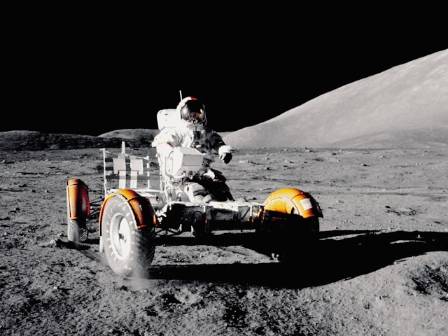
Between 1969 and 1972, NASA’s Apollo program sent 12 American astronauts to walk on the Moon. During these missions, astronauts used the Lunar Roving Vehicle to travel across the surface, allowing them to explore larger areas and conduct scientific research.
The Apollo astronauts studied many aspects of the lunar environment, including soil properties, micrometeorite activity, lunar distance measurements, magnetic fields, and solar wind effects. They also collected and returned approximately 382 kilograms (842 pounds) of lunar rocks and soil samples to Earth for detailed analysis.
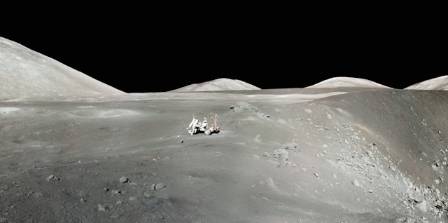
One of the most famous moments occurred during Apollo 17 in December 1972. Scientist-astronaut Harrison H. Schmitt was photographed examining a large boulder at Station 6 near the base of the North Massif in the Taurus-Littrow Valley. The Lunar Roving Vehicle can be seen nearby, while astronaut Eugene A. Cernan captured the image during the mission’s third moonwalk. Schmitt served as the lunar module pilot, while Cernan and command module pilot Ronald E. Evans completed the final Apollo mission activities in lunar orbit and on the surface.
The Return of Robotic Lunar Missions
After the Apollo program ended, lunar exploration entered a long period of reduced activity. NASA restarted major lunar research efforts in the 1990s through robotic missions including Clementine and Lunar Prospector.
Data collected from these missions suggested that frozen water might exist near the Moon’s polar regions. However, when the Prospector spacecraft was intentionally crashed into the lunar surface, no visible evidence of water was detected.
NASA began another wave of robotic lunar exploration in 2009 with the launch of the Lunar Reconnaissance Orbiter (LRO) and the Lunar Crater Observation and Sensing Satellite (LCROSS). These missions provided detailed information about the lunar surface and helped scientists better understand possible resources on the Moon.
In 2011, two modified spacecraft began the ARTEMIS mission, which studied the Moon’s interaction with the solar wind and Earth’s magnetic environment. In 2012, NASA’s Gravity Recovery and Interior Laboratory (GRAIL) mission used two spacecraft to map the Moon’s gravitational field, creating the most detailed gravity map ever produced for a celestial body.
NASA’s Artemis Program and Future Moon Missions
In March 2019, NASA announced plans to return American astronauts to the lunar surface through the Artemis program. The goal of Artemis is to develop new technologies, conduct scientific research, and prepare for future human exploration beyond the Moon.
In November 2022, Artemis I completed the first full mission test of the Orion spacecraft and Space Launch System rocket, demonstrating key systems needed for future crewed missions.
In April 2026, Artemis II successfully carried four astronauts around the far side of the Moon before returning safely to Earth. This mission marked another major step toward renewed human exploration of the lunar environment and future missions to deeper regions of space.
Nearby projects

· en
Mastering the Art of Homemade Ice Cream: Essential Tips for Creamy Delights
Ryan Elliot

· en
The 5 Most Enchanting Cities to Experience Under the Stars
Ava

· en
Arctic Sea Ice Shrinks To Lowest Winter Level Ever As Unprecedented Global Heat Shatters Records
Parker Lillian

· en
Moose: The Giant of the Deer Family
Sylas Donovan

· en
Thirteen Architectural Wonders Every Student Should Know
Audrey Foster

· en
The Ultimate Guide To Finding The Best Single Sofa
Blair Carter