DIY note
Gray Wolf: The Largest Wild Member of the Dog Family
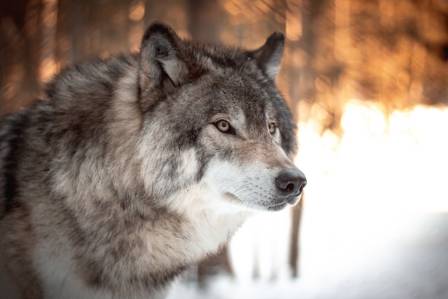
The gray wolf is the biggest wild species within the Canidae family. It has a powerful body, long legs, and a slim chest that help it travel long distances efficiently. Its wide skull narrows into a pointed muzzle, while its thick, bushy tail often has a darker tip.
Jessica Coleman
Maker
Bench tip
Read the full note below and keep tools nearby.
Shelf
Hobby build
The gray wolf is the biggest wild species within the Canidae family. It has a powerful body, long legs, and a slim chest that help it travel long distances efficiently. Its wide skull narrows into a pointed muzzle, while its thick, bushy tail often has a darker tip.
Gray wolves have a thick outer layer of coarse fur and a dense inner coat that keeps them warm in extreme environments. Their fur colors can differ greatly depending on location and genetics. Arctic wolves may have almost completely white coats, while other populations can display shades of gray, brown, reddish-brown, cinnamon, or black. Some wolves are entirely black or white.
Size and Physical Features
The size of an adult gray wolf depends largely on where it lives. Wolves from colder northern regions are generally larger than those found farther south.
Male gray wolves usually weigh between 70 and 145 pounds (32 to 65 kilograms), while females commonly weigh between 60 and 100 pounds (27 to 45 kilograms). Their body length is typically between 3 and 5 feet (0.9 to 1.5 meters), with an additional 1 to 2 feet (0.3 to 0.6 meters) from the tail. Their shoulder height ranges from approximately 26 to 33 inches (66 to 84 centimeters).
Geographic Range
Historically, gray wolves occupied large areas throughout the Northern Hemisphere, including regions of Europe, Asia, and North America. In the past, they lived across more than two-thirds of the United States, adapting to environments ranging from northeastern forests to southwestern deserts.
However, decades of hunting, predator-control programs, and habitat destruction caused wolf populations to disappear from much of the lower United States by the middle of the 20th century.
Today, gray wolves have recovered in several areas. They remain widely distributed throughout Alaska and have established populations in parts of the contiguous United States. Important populations exist in the Northern Rocky Mountains, including Montana, Idaho, and Wyoming, as well as the western Great Lakes region of Minnesota, Wisconsin, and Michigan. Smaller groups can also be found in Washington, Oregon, Colorado, and California.
Diet and Hunting Behavior
Gray wolves are meat-eating predators that mainly feed on large hoofed mammals. Their preferred prey includes elk, moose, deer, bison, and caribou. The animals they hunt often depend on what is available in their local environment and the changing seasons.
For example, wolves in the Northern Rockies commonly hunt elk and deer, while Arctic wolves often rely more heavily on caribou and muskoxen. They usually work together in packs to chase, separate, and capture larger prey, although individual wolves may hunt smaller animals alone.
Gray wolves also eat smaller creatures such as beavers, rabbits, rodents, birds, and sometimes fish. Coastal wolves in the Pacific Northwest, sometimes called “sea wolves,” have developed semi-aquatic behaviors and frequently catch fish. When food is limited, wolves may also eat carrion, fruits, or berries, showing their ability to adapt to different food sources.
Their feeding pattern is based on periods of abundance and scarcity. After a successful hunt, an adult wolf can eat as much as 20 pounds of meat in one meal, but it may survive several days without food when prey is difficult to find.
Social Life and Pack Structure
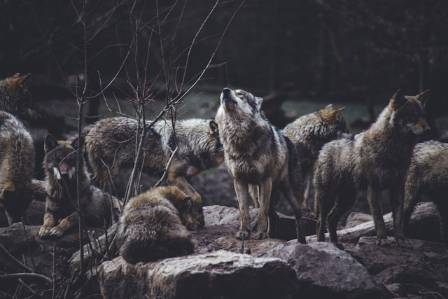
Gray wolves are highly social animals that live in family groups known as packs. Most packs contain around four to nine wolves, although some groups may be smaller or grow to as many as 15 individuals. Occasionally, very large packs can reach about 30 members before younger wolves leave to establish their own territories.
A typical pack consists of a dominant breeding pair and several generations of their offspring. Some young wolves eventually leave their original pack and become traveling individuals searching for a new territory and a potential mate. Depending on food availability and habitat conditions, they may move nearby or travel hundreds of miles before forming a new pack.
Reproduction and Raising Pups
Gray wolves usually form lifelong partnerships with their mates, although a surviving wolf may find a new partner if its mate dies. In northern regions of the United States, breeding usually occurs between late January and March, while wolves in warmer southern areas breed earlier.
The pregnancy period lasts about 63 days, and females typically give birth to four to six pups. Newborn pups are usually born inside a den and arrive unable to see or hear. They weigh only about one pound at birth.
Young wolves begin eating solid food after being weaned at around six weeks old. Because adult wolves may travel far from the den while hunting, they often carry food back by eating meat and later regurgitating it for the pups. The mother may move the pups to different den locations every few months until autumn, when the pack begins living more freely.
In the wild, gray wolves generally live between 8 and 13 years, while wolves in captivity may survive beyond 15 years.
Conservation and Recovery Efforts
Gray wolves are protected under federal endangered species laws in many areas. Although some populations are stable or increasing, their numbers remain much lower than historical levels because of habitat loss, conflicts with livestock, human persecution, and past predator-control efforts.
Large wolf populations continue to thrive in Alaska and Canada, but wolves were nearly eliminated from most of the lower 48 states by the mid-1900s, except for parts of the Great Lakes region.
In 1995, gray wolves were reintroduced to Yellowstone National Park, where they successfully established a stable population in the Northern Rockies. These wolves later expanded into parts of the Pacific Northwest and northern California.
Wolf restoration programs have also expanded into Colorado, where the first reintroduced wolves were released onto public lands in December 2023. The Mexican gray wolf, a subspecies of gray wolf, has also been returned to areas of Arizona and New Mexico. Research from Yellowstone has shown that restoring wolves can help rebuild ecosystems by returning an important top predator to its natural role.
Interesting Gray Wolf Facts
A healthy gray wolf usually needs around 5 to 7 pounds of meat each day to maintain its body condition and support reproduction.
Gray wolves communicate through a combination of howls, other vocal sounds, and body movements. A wolf showing submission may lower its body, whimper, tuck its tail, lick another wolf’s mouth, or roll onto its back.
The idea that “lone wolves” are naturally independent animals is a misconception. Wolves are highly social creatures, and individuals living alone are usually searching for a mate and a new territory rather than choosing a solitary lifestyle.
Wolf pups receive care from older siblings, who help protect them, play with them, and provide companionship while the adult wolves are away hunting.
Nearby projects

· en
Top 5 Most Beautiful Coasts in the World
Evelina Shaw

· en
The difference between seals and sea lions
Coren Maddox

· en
Is Orange Juice Healthy? A Balanced Look at Its Benefits and Drawbacks
Fiona Blake

· en
Shape-Shifting Cube Robots for Space
Taylor Morgan

· en
Best Ocean Boats: Types and Brands to Buy
Vivian Maxwell

· en
Nuclear Fusion: The Future of Clean Energy
Liam Bennett