DIY note
Jupiter: The Solar System’s Giant Planet
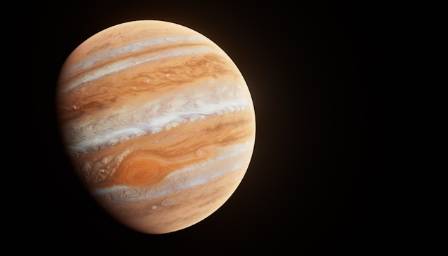
When Jupiter rises above the horizon, it shines with a steady brilliance that has captivated skywatchers for thousands of years. To the naked eye, it appears as a bright wandering star, but in reality it is a colossal world that dominates our planetary neighborhood. As the largest planet in the solar system, Jupiter has played a crucial role in shaping the formation, structure, and evolution of the worlds around it.
Rowan Blake
Maker
Bench tip
Read the full note below and keep tools nearby.
Shelf
Hobby build
When Jupiter rises above the horizon, it shines with a steady brilliance that has captivated skywatchers for thousands of years. To the naked eye, it appears as a bright wandering star, but in reality it is a colossal world that dominates our planetary neighborhood. As the largest planet in the solar system, Jupiter has played a crucial role in shaping the formation, structure, and evolution of the worlds around it.
Studying Jupiter offers a window into the origins of the solar system itself. From its immense size and turbulent atmosphere to its remarkable moons and powerful magnetic field, Jupiter remains one of the most fascinating objects in space.
The Discovery and Name of Jupiter
Jupiter has been visible to humans since ancient times because of its brightness in the night sky. Early civilizations noticed that it moved differently from the fixed stars, identifying it as one of the wandering planets.
The Romans named the planet after Jupiter, the supreme deity in their mythology. The Greeks associated it with Zeus, ruler of the gods. Across many cultures, the planet symbolized strength, leadership, and authority.
A major breakthrough came in 1610 when astronomer Galileo Galilei pointed a telescope toward Jupiter. He discovered four large moons orbiting the planet: Io, Europa, Ganymede, and Callisto.
This observation demonstrated that not everything revolved around Earth and provided powerful evidence for the heliocentric model of the solar system.
Jupiter’s Position in the Solar System
Jupiter is the fifth planet from the Sun and orbits at an average distance of about 778 million kilometers. It takes nearly 12 Earth years to complete one trip around the Sun.
What makes Jupiter especially important is its enormous mass. The planet contains more than twice the mass of all the other planets combined. Its gravitational influence affects the motions of asteroids, comets, and neighboring planets.
Jupiter helps shape the architecture of the solar system by capturing, redirecting, or disturbing countless smaller objects. Its presence has played a major role in determining the arrangement and stability of planetary orbits.
The Enormous Size of Jupiter
Jupiter is classified as a gas giant, though the term hardly conveys its true scale. With a diameter of approximately 143,000 kilometers, it is more than eleven times wider than Earth.
More than 1,300 Earth-sized worlds could fit inside Jupiter’s volume.
Unlike Earth, Jupiter does not have a solid surface. It consists primarily of hydrogen and helium, the same elements that make up the Sun. Because of this composition, scientists sometimes describe Jupiter as a failed star—a body that never accumulated enough mass to begin nuclear fusion.
Inside Jupiter
Jupiter’s internal structure is layered and complex.
Its outer region contains thick cloud layers that surround the entire planet. Beneath the visible atmosphere lies a deep zone of compressed gases that gradually become liquid-like under extreme pressure.
Farther down, hydrogen is squeezed into a metallic state capable of conducting electricity. This unusual form of hydrogen is believed to be responsible for generating Jupiter’s powerful magnetic field.
At the center may lie a dense core composed of heavier elements, although scientists continue to debate its exact nature and composition.
A World of Giant Storms
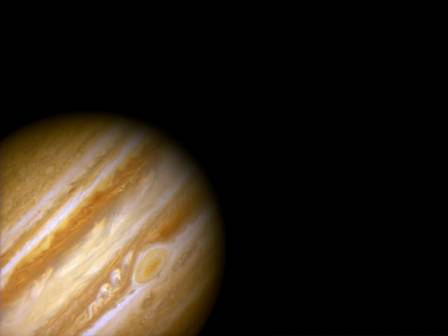
Jupiter’s atmosphere is among the most spectacular sights in the solar system. Colorful cloud bands wrap around the planet in alternating stripes of white, brown, orange, and red.
These bands, known as belts and zones, move in opposite directions, creating intense turbulence and powerful weather systems.
Wind speeds can exceed 600 kilometers per hour, producing storms far larger than anything seen on Earth.
The most famous storm is the Great Red Spot, a gigantic cyclone that has been active for at least three centuries. Large enough to contain Earth, this storm continues to churn through Jupiter’s atmosphere, although observations show it has gradually been shrinking.
The planet’s atmosphere remains in constant motion, with storms forming, evolving, and disappearing over time.
Jupiter’s Powerful Magnetic Field
Jupiter possesses the strongest planetary magnetic field in the solar system.
The field is generated by the movement of metallic hydrogen deep within the planet. This process creates an enormous magnetosphere that stretches millions of kilometers into space.
The magnetosphere traps charged particles and produces intense radiation belts around the planet. These radiation zones can pose serious challenges to spacecraft operating in the Jovian system.
The magnetic field also creates brilliant auroras near Jupiter’s poles. These displays are far more energetic than Earth’s northern and southern lights and are fueled by both the solar wind and material supplied by Jupiter’s moons.
Jupiter’s Remarkable Moons
More than ninety moons orbit Jupiter, forming a miniature planetary system.
The four largest moons, known as the Galilean moons, are particularly important.
Io is the most volcanically active world in the solar system, with frequent eruptions reshaping its surface.
Europa is covered by a thick shell of ice that hides a vast liquid-water ocean beneath. Because of this subsurface ocean, Europa is considered one of the most promising places to search for extraterrestrial life.
Ganymede is the largest moon in the solar system. It is even larger than the planet Mercury and possesses its own magnetic field.
Callisto is heavily scarred by impact craters, preserving evidence of ancient events from the early solar system.
Together, these moons provide scientists with valuable clues about planetary formation and the potential for life beyond Earth.
Jupiter’s Ring System
Although Saturn is famous for its rings, Jupiter also has a ring system.
These rings are faint and composed primarily of tiny dust particles created by impacts on small moons. Because they are so thin and dim, they are difficult to observe from Earth.
Despite their subtle appearance, Jupiter’s rings help researchers understand how dust and debris behave around large planets.
How Jupiter Formed
Jupiter formed approximately 4.5 billion years ago during the birth of the solar system.
Scientists believe the planet began as a core of rock and ice that rapidly accumulated gas from the surrounding protoplanetary disk. Because it formed early, Jupiter captured enormous amounts of hydrogen and helium before those materials were swept away by solar activity.
Its immense gravity influenced the development of other planets, the asteroid belt, and countless smaller objects. Jupiter’s formation is closely linked to the overall history of the solar system.
Exploring Jupiter
Human exploration of Jupiter began with telescopic observations and later expanded through robotic missions.
The spacecraft Pioneer 10 and Pioneer 11 provided the first close-up views of the giant planet.
The Voyager 1 and Voyager 2 missions revealed extraordinary details about Jupiter and its moons.
Later, the Galileo spacecraft spent years studying the Jovian system from orbit.
Today, the Juno mission continues to investigate Jupiter’s atmosphere, magnetic field, and internal structure, providing insights never before possible.
Jupiter’s Influence on Earth
Jupiter is often described as a gravitational shield for the inner solar system.
Its enormous mass can capture or redirect comets and asteroids that might otherwise threaten Earth. However, Jupiter’s influence is complex, and in some situations it can also send objects toward the inner planets.
Even so, Jupiter has played a significant role in shaping the environment in which Earth developed.
Unanswered Questions
Despite centuries of observation, Jupiter still contains many mysteries.
Scientists continue to investigate the structure of its core, the mechanisms that power its storms, and the origins of its magnetic field.
Researchers are also studying whether Europa’s hidden ocean could support life and how Jupiter’s extensive moon system formed.
Each new discovery reveals that the giant planet is even more complex than previously imagined.
Conclusion
Jupiter is far more than the largest planet in the solar system. It is a dynamic world of immense storms, powerful magnetic forces, intricate rings, and extraordinary moons.
Its gravity has shaped the solar system, its atmosphere showcases extreme weather on a colossal scale, and its moons may hold clues to one of humanity’s greatest questions: whether life exists beyond Earth.
As astronomers continue to explore Jupiter, the giant planet remains a symbol of the wonders that await discovery in the vast universe beyond our world.
Nearby projects

· en
Classic coupes that aged like fine wine
Olivia Sterling

· en
Oriental Pearl Tower
Sienna Clarke
· en
Thirteen Architectural Wonders Every Student Should Know
Audrey Foster

· en
The best smartwatches
Tyler Vaughn

· en
How Do Western and Asian Architectural Styles Differ?
Daniel Moore

· en
The Timeless Charm of Mountain Houses with Natural Stone
Cora Winslow