DIY note
Scarlet Tanager: The Red Bird Hidden in the Forest
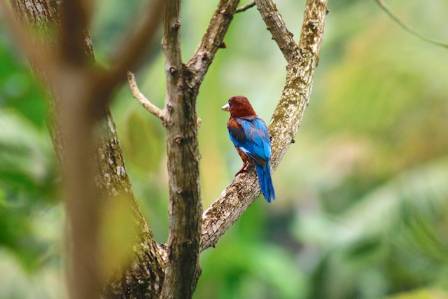
The Scarlet Tanager is a striking, medium-sized songbird that is roughly comparable in size to a Baltimore Oriole, with a body length of about 16–17 cm. During the breeding season, the male is especially eye-catching, featuring vivid red plumage and a red tail contrasted by deep black wings and a pale-colored bill.
Lyra Beaumont
Maker
Bench tip
Read the full note below and keep tools nearby.
Shelf
Hobby build
The Scarlet Tanager is a striking, medium-sized songbird that is roughly comparable in size to a Baltimore Oriole, with a body length of about 16–17 cm. During the breeding season, the male is especially eye-catching, featuring vivid red plumage and a red tail contrasted by deep black wings and a pale-colored bill.
The species is both sexually dimorphic and dichromatic, meaning males and females have noticeably different appearances. Females are primarily olive-colored, with olive-brown wings, a greenish tail, and an olive-yellow underside and eyelids. Outside the breeding season, adult males become similar in appearance to females, although they generally retain brighter coloration.
Female and immature Scarlet Tanagers can sometimes be mistaken for female or immature Summer Tanagers because their plumage is quite similar. Their vocalizations, however, make them much easier to tell apart. During the molting period, male Scarlet Tanagers can look particularly unusual, developing irregular patches of orange, red, and yellow as their old feathers are replaced by new ones.
Vocalization
Scarlet Tanagers are known for their distinctive robin-like Chip-Churr calls. Because these birds tend to remain hidden within the foliage, they are often easier to locate by listening for their calls than by trying to spot them visually.
Habitat and Nesting
Scarlet Tanagers breed throughout the eastern United States and southeastern Canada, with their breeding distribution largely corresponding to the Eastern Deciduous Forest Biome. During the winter, they move southward into the southeastern United States, Central America, and northwestern parts of South America. They generally spend this period in primary forests, mature second-growth forests, and forest-edge habitats.
Scarlet Tanagers are monogamous and highly territorial. They favor mature deciduous woodlands, particularly forests containing oak trees. For a population to remain viable, the habitat generally needs to include relatively large, continuous forest areas of at least 25 acres rather than heavily fragmented woodland.
Breeding usually gets underway from late April through early May. Nest construction typically starts about a week after courtship. The female selects the specific nesting location, building the nest among foliage within an area where the male has conducted his courtship displays. Eggs are generally laid within two days after the nest is finished. Incubation lasts approximately 14 days, and the young typically leave the nest about 15 days after hatching.
Diet and Foraging
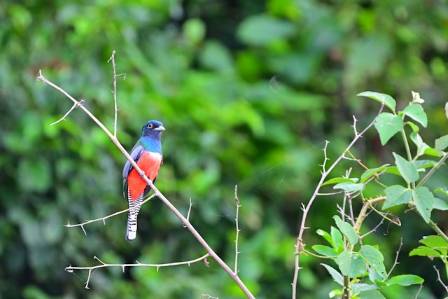
Throughout the breeding season, Scarlet Tanagers feed primarily on insects. Their diet includes ants, moths, butterflies, spiders, and many other invertebrates.
They often search for prey high in the forest canopy or along tree trunks, using their bills to investigate bark for hidden insects. They may also collect insects from leaves, flowers, and bark while perched on a branch or hovering nearby, a behavior known as gleaning.
Scarlet Tanagers also practice hawking, catching insects directly from the air while in flight. In addition to feeding in trees, they sometimes search for insects on the ground. Their diet can also include berries, soft young buds, and occasionally nectar.
When and Where to Find Scarlet Tanagers at Schlitz Audubon
At Schlitz Audubon, Scarlet Tanager sightings are most frequent in May during spring migration. They are generally encountered in the Center’s forested habitats, although their presence is often revealed by their distinctive calls before the birds themselves become visible.
Other Interesting Facts
The Scarlet Tanager belongs to the family Cardinalidae, the same bird family that includes the Northern Cardinal.
These birds may occasionally drink along the edges of streams and puddles, and they sometimes visit bird baths as well.
During the winter months in Central and South America, Scarlet Tanagers can form mixed-species flocks with flycatchers, antbirds, woodcreepers, and native tropical tanagers.
Nearby projects

· en
Top 10 Things to Do at Hopetoun House
Ellen

· en
Why Cats Make Remarkable Companions
Samantha Rowan

· en
Science-Backed Benefits of Rock Climbing in 2025
Luke

· en
Top 3 Theme Parks
Ava

· en
Top 10 Bay Window Dining Table Ideas
Clara Wren

· en
Fostering Positive Vibes: 5 Plants to Elevate Your Home's Energy
Charlotte Ivy