DIY note
Best classic cars for a small garage
It’s ironic that as family cars grow ever larger—thanks in part to SUVs and increasing safety standards—our garages and parking spaces remain essentially unchanged. As a result, many new garages end up housing bicycles, freezers, lawnmowers, and all manner of items, rather than the cars they were built for.
Leo James
Maker
Bench tip
Read the full note below and keep tools nearby.
Shelf
Hobby build
It’s ironic that as family cars grow ever larger—thanks in part to SUVs and increasing safety standards—our garages and parking spaces remain essentially unchanged. As a result, many new garages end up housing bicycles, freezers, lawnmowers, and all manner of items, rather than the cars they were built for.
Most single garages measure around six metres long and three metres wide, though some are slightly smaller, around 5.8 metres by 2.5 metres. Doors are naturally narrower, so you need enough clearance to open your car door fully without getting stuck. Many modern cars are simply too big for a standard single garage. However, classic cars, with their smaller footprints, can maximize the space and still leave room to work under the hood or store a workbench. Here are some of the best options for classics that fit neatly into today’s garages.
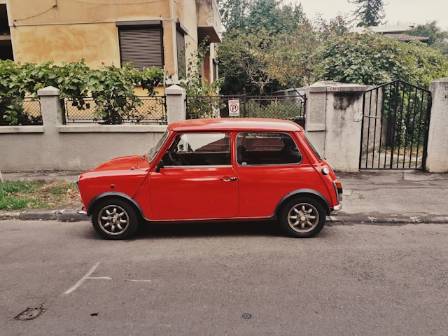
Mini
Few classics are easier to park than the Mini. Introduced in 1959 and designed by Alec Issigonis, the Mini remained in production for over four decades. Its front-wheel-drive layout and clever packaging made it a benchmark for small cars.
From the original Austin Seven and Morris Mini-Minor to rally-winning Coopers, Clubman, Mayfair, and later ’90s Coopers, the Mini evolved into a well-equipped and stylish city car.
Choosing the right model depends on your budget. The MkI Cooper S is a dream car but often exceeds £40,000. A standard Mk1 in excellent condition costs around £20,000, while a Mk2 or ’80s City E/Mayfair is more affordable at £5,000–8,000. Later Coopers may fetch £8,000–12,000.
Rust is the Mini’s main weakness, affecting wings, subframes, floorpans, and sills. Fortunately, spare parts are widely available.
Morris Minor
Another Issigonis design, the Morris Minor is ideal for compact garages. Famous for being the first British car to surpass a million sales, it remains popular among first-time classic buyers.
The Minor 1000, introduced in 1956, upgraded the A-series engine to 948cc (later 1098cc), improving performance and making it a more relaxed drive. Later models offered smoother gearboxes and additional power, keeping it competitive throughout the 1960s.
Early Series MM models are collectible but less practical. Minor 1000 saloons offer better performance and value, with decent cars available for £4,000 and well-kept examples for £6,000–7,000. Tourers and Travellers are rarer, commanding higher prices.
Vauxhall Viva (HA)
Launched in 1963, the Viva marked Vauxhall’s return to the small-saloon market, competing with Ford’s Anglia and BMC’s 1100. Its rear-wheel-drive layout, 1057cc engine, and all-synchromesh gearbox made it a nimble, enjoyable car to drive.
The 1965 Viva 90 introduced a 60bhp high-compression engine, Stromberg carburettor, and front disc brakes, delivering over 80mph. Fewer than 12,000 were produced, making it a rare find. Regular HA Vivas are excellent value at £4,000–5,000, with top-condition examples fetching up to £8,000.
MG Midget
BMC expanded the small-roadster market with the MG Midget, introduced in 1961 alongside the Mk2 Austin-Healey Sprite. The Midget, with a monocoque design, simple interior, and initially a 948cc engine (later 1098cc, 1275cc, and 1500cc), became a global hit.
The Mk3 Midget, with a 1275cc engine and upgraded interior, remains a favourite. The 1500, with rubber bumpers and an ex-Triumph engine, is easier to find and good value. Most Midgets fit comfortably in a single garage. Expect to pay £8,000–10,000 for a solid 1500, with early models costing more.
Mazda MX-5 Mk1
When Mazda launched the MX-5 in 1989, it revived the classic roadster market. With rear-wheel drive, a soft top, and a lively twin-cam engine, it captured enthusiasts’ hearts.
The 1994 1.8-litre model improved performance over the earlier 1.6-litre. Entry-level 1.6-litre models remained fun and affordable. Limited editions added variety before the final Mk1 rolled out in 1998.
Mk1 MX-5s can be bought from £2,500 for cosmetic projects, £5,000 for solid examples, and £10,000–12,000 for pristine, low-mileage cars. Rust is the primary concern.
Triumph Spitfire
The Triumph Spitfire, launched in 1962, was a small, sporty two-seater with a lively 1147cc engine. Early handling could be tricky due to the swing-axle rear setup.
The Mk2 (1965) added power, the Mk3 introduced a folding soft top and higher bumpers, and the Mk4 (1970) improved rear suspension and modernized styling. The 1500, with a 1493cc engine, was the final iteration. Prices for a tidy Mk4 or 1500 range from £6,000–8,000, with early models costing more.
Volkswagen Golf Mk1
The Golf Mk1 (1974) revolutionized small-family cars with front-wheel drive, a hatchback body, and modern handling. Alongside standard models, the GTi injected performance and driving excitement, pairing a fuel-injected engine with sharper suspension.
Non-GTi Golfs are excellent classics for daily use, fitting comfortably in a single garage. Prices range from £4,000–6,000, while GTis can fetch £15,000–20,000 or more.
Ford Fiesta Mk1
Launched in Europe in 1976, the Fiesta was Ford’s first front-wheel-drive production car. Its ‘Valencia’ engines (957cc, 1117cc, later 1.3–1.6L) delivered lively performance, complemented by nimble handling and a practical interior.
The XR2 variant is highly sought-after, fetching £15,000–20,000, while standard models are more affordable at £2,500–3,500.
Jaguar Mk2
Slightly larger but still suitable for a single garage, the Jaguar Mk2 (1959) offered a luxurious ride with updated styling, increased glass area, and powerful 2.4-, 3.4-, and 3.8-litre engines. Dunlop disc brakes and a wider track enhanced handling.
Top-condition 3.8s can cost £45,000–60,000, while 240s or 340s offer more affordable options at £15,000–20,000.
These classics combine timeless style, compact dimensions, and practicality, making them ideal choices for garages that modern cars struggle to fit into. Choosing the right model lets you enjoy the full experience of owning and working on a car, even in limited space.
Nearby projects

· en
Mastering the Art of White Dressing
Sophia Harper

· en
Best Single Chairs for Living Room
Chloe Dean

· en
Easy Ways to Enjoy This Traditional Matcha
Chloe Dawn

· en
Interesting Facts About Ducks You May Not Know
Evan Taylor

· en
Creating Botanical Collages from Scratch
Ethan Blake

· en
Top 5 Waterfalls
Eliana Kingsley