DIY note
Blue Tears
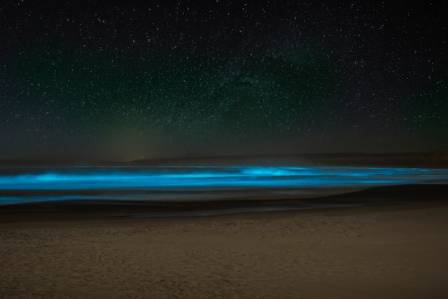
In recent years, the phenomenon known as “blue tears” has attracted increasing attention in China. This term describes moments when the ocean surface glows with a mysterious blue light under the moonlight. One of the most famous locations to witness this breathtaking natural event is Pingtan Island (25°16’-25°44’N, 119°32’-120°10’E), a county under the administration of Fuzhou, Fujian Province.
Damon Wells
Maker
Bench tip
Read the full note below and keep tools nearby.
Shelf
Hobby build
In recent years, the phenomenon known as “blue tears” has attracted increasing attention in China. This term describes moments when the ocean surface glows with a mysterious blue light under the moonlight. One of the most famous locations to witness this breathtaking natural event is Pingtan Island (25°16’-25°44’N, 119°32’-120°10’E), a county under the administration of Fuzhou, Fujian Province.
Because Pingtan Island was historically separated from the mainland areas of Fuzhou and lacked direct land transportation, local communities preserved much of their traditional culture and natural landscapes. For many years, residents relied mainly on boats and ships to travel between the island and other areas.
The increasing popularity of “blue tears” has brought more visitors to Pingtan Island, with tourists traveling there to experience the unusual glowing coastline. After spending long periods in busy urban environments, many people seek natural scenery as a way to relax and reconnect with nature.
During nights when “blue tears” appear, beaches and rocky shorelines often become crowded with visitors waiting to witness the glowing waves. Sitting beside the ocean, people can enjoy gentle sea breezes, the sound of waves, and the beauty of the night sky while watching the water sparkle with blue light.
Today, “blue tears” has become one of Pingtan Island’s most recognizable attractions and has played an important role in promoting local tourism.
The poetic expression “blue tears” has become widely familiar because media outlets frequently use the phrase when reporting this natural phenomenon. However, many visitors do not fully understand what causes this glowing effect, what environmental conditions create it, or what ecological meanings may exist behind it.
How Are “Blue Tears” Formed?
The phenomenon called “blue tears” is actually a form of bioluminescence, which is a natural process where living organisms produce light. The broader concept of luminescence was introduced in 1888 by German physicist and science historian Eilhardt Wiedemann (1852–1928), who used the term to describe light-producing events that do not depend only on high temperatures.
Wiedemann explained that luminescence, often described as “cold light,” differs from incandescence, which is produced through heat. Based on the way light is generated, he classified luminescence into several categories, including photoluminescence, thermoluminescence, electroluminescence, crystalloluminescence, triboluminescence, and chemiluminescence. According to this classification, bioluminescence belongs to the category of chemiluminescence.
During the twentieth century, scientists continued expanding their understanding of luminescence. In his 1957 book A History of Luminescence, American zoologist Edmund Newton Harvey from Princeton University provided a more detailed classification of different forms of light emission.
Harvey separated bioluminescence from chemiluminescence and defined it as the emission of light produced through chemical reactions within living organisms, including animals and plants. His research helped establish a clearer scientific explanation of bioluminescence.
Long before publishing his book, Harvey had already studied glowing marine organisms, including protozoans such as flagellates and small crustaceans such as ostracods. These organisms remain important examples when scientists explain marine bioluminescence today.
In 1917, Harvey published Studies on Bioluminescence, based on his research into Cypridina hilgendorfii, a Japanese ostracod species. He suggested that luciferase plays a key role in producing light and that chemical substances involved in the reaction, including luciferin and luciferase, are essential components of marine bioluminescent systems.
With advances in modern science and technology, researchers have developed a much deeper understanding of bioluminescence. Studies by Steven H. D. Haddock, Mark A. Moline, and James F. Case examined the diversity, evolution, chemistry, molecular biology, ecological functions, and distribution of bioluminescent organisms.
Their research showed that many types of marine organisms can produce light, including bacteria, dinoflagellates, radiolarians, ctenophores, cnidarians, annelids, mollusks, crustaceans, echinoderms, tunicates, fish, and other marine worms.
What Causes “Blue Tears” and “Milky Seas”?
Although many marine organisms have the ability to create bioluminescence, microorganisms are the main sources behind many famous glowing ocean events.
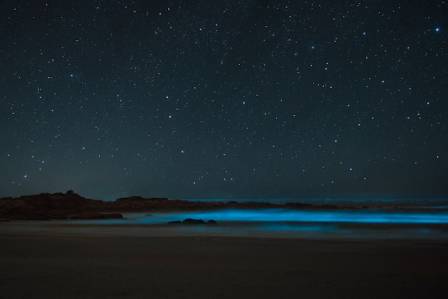
The “blue tears” phenomenon around Pingtan Island is mainly caused by the crustacean Vargula hilgendorfii, also known as Cypridina hilgendorfii, sea firefly, or blue sand. These tiny organisms release blue light when disturbed by movement in the water.
In other parts of the world, similar glowing events may have different biological causes. For example, coastal waters in southern California often glow because of large populations of bioluminescent dinoflagellates called Lingulodinium polyedra. These organisms commonly appear during red tide events and emit blue light when stimulated by waves or water movement.
Different cultures use different names to describe marine bioluminescence. In China, it is commonly called “blue tears,” while some regions refer to similar glowing ocean events as “milky seas.” Despite the differences in terminology, many people focus mainly on the visual beauty of the phenomenon rather than the scientific processes behind it.
The distance between scientific research and public understanding exists partly because communication between researchers and society remains limited. Scientists study bioluminescence not only because of its natural beauty but also because of its potential applications.
Harvey emphasized that luminescence research has contributed to technological development, including advances in lighting, communication, and scientific discoveries. Bioluminescence may also provide valuable applications in medicine, biotechnology, and other fields.
However, scientific research sometimes pays less attention to environmental concerns. The ecological consequences of certain bioluminescent organisms need further investigation, especially when population increases affect marine ecosystems.
Some species of dinoflagellates can contribute to harmful environmental changes. Research has shown that large populations of organisms such as Gonyaulax (Lingulodinium), Noctiluca, Protoperidinium, and Pyrocystis may contribute to toxic red tide events.
For example, red tides and glowing waters along the coast of Southern California are associated with the bioluminescent dinoflagellate Lingulodinium polyedrum, previously known as Gonyaulax polyedra.
What Are the Environmental Impacts of “Blue Tears”?
Many members of the public are unaware of the possible environmental meanings behind “blue tears.” Media coverage often focuses more heavily on the beauty and tourism value of glowing waters than on related ecological issues.
Research and media reports in Fujian Province show that public attention toward “blue tears” has generally been greater than attention toward red tides, even though both phenomena may involve changes in marine ecosystems.
Another issue is that most studies of marine bioluminescence have been conducted by natural scientists, while researchers in fields such as environmental history and humanities have paid less attention to these microscopic marine processes.
Marine environmental studies have traditionally focused on larger organisms, such as fish, and visible forms of pollution, including plastic waste and oil contamination. Meanwhile, microorganisms responsible for phenomena like “blue tears” and tiny pollutants such as microplastics have received less attention outside scientific communities.
Conclusion
The relationship between coastal tourism, marine environmental changes, and knowledge of ocean bioluminescence can be clearly seen through the story of “blue tears.”
Visitors are fascinated by the magical appearance of glowing seas, yet many do not understand the biological processes responsible for this phenomenon. Scientists have studied marine bioluminescence for more than a century and have achieved significant progress, but many questions remain unanswered, including the possible environmental consequences of these events.
There is still a gap between scientific knowledge, interpretations from the humanities, public perceptions of “blue tears,” and the actual condition of marine ecosystems.
Future research on marine bioluminescence should continue exploring not only the scientific mechanisms behind glowing oceans but also their ecological significance and relationship with environmental change.
Nearby projects

· en
Winter beauty: Explore forests under a coat of white
Nolan Reese

· en
Top 5 Hall of Fame Pool Players: Legends Who Redefined the Game
Lily
· en
Mountain Lakes Wilderness
Julian Marlowe

· en
The Healing Power of Art and Drawing
Ryan Mitchell

· en
Our Top 10 Most Distinctive Coin Banks
Robert Williams

· en
How to Build the Perfect Tea Station
Nolan Carlisle