DIY note
Eight Secrets of the Taj Mahal
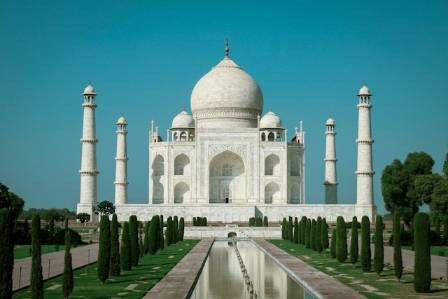
For anyone visiting India for the first time, the world-famous Taj Mahal is almost impossible to leave off the itinerary. Located in Agra, this magnificent mausoleum is widely regarded as India’s most recognizable monument and stands as one of history’s most celebrated expressions of eternal love. Construction took place between 1632 and 1647 under Mughal Emperor Shah Jahan, who dedicated the monument to his beloved wife, Mumtaz Mahal, after she died while giving birth. Despite its worldwide fame, the Taj Mahal still has many fascinating details and stories that are not widely known.
Maelin Frost
Maker
Bench tip
Read the full note below and keep tools nearby.
Shelf
Hobby build
For anyone visiting India for the first time, the world-famous Taj Mahal is almost impossible to leave off the itinerary. Located in Agra, this magnificent mausoleum is widely regarded as India’s most recognizable monument and stands as one of history’s most celebrated expressions of eternal love. Construction took place between 1632 and 1647 under Mughal Emperor Shah Jahan, who dedicated the monument to his beloved wife, Mumtaz Mahal, after she died while giving birth. Despite its worldwide fame, the Taj Mahal still has many fascinating details and stories that are not widely known.
Optical Illusions Can Be Seen Throughout the Monument
The architects and craftsmen responsible for the Taj Mahal had an extraordinary understanding of proportion, perspective, and visual perception. When approaching the monument through the main gateway that frames the building, the Taj Mahal can initially appear surprisingly enormous and close. Yet as visitors move toward it, the monument seems to become smaller, creating an effect that is contrary to what the eye normally expects.
The minarets surrounding the central tomb provide another example of careful design. Although they appear to stand completely straight, each tower actually angles slightly outward. This arrangement contributes to the visual balance of the complex while also serving a practical purpose. In the event of an earthquake or another disaster, the outward tilt would help ensure that a collapsing minaret would fall away from the central tomb.
The Most Famous Legend Is Probably Untrue
One of the most widely repeated stories about the Taj Mahal claims that Shah Jahan was determined to make his mausoleum so extraordinary that nobody could ever reproduce its beauty. According to the legend, he ordered the hands of the artisans and craftsmen cut off and had their eyes destroyed so they would never be able to create anything comparable.
Although this gruesome tale has been repeated for generations, historians have found no reliable evidence proving that such punishment ever took place. The story has nevertheless become deeply associated with the Taj Mahal and adds an element of tragedy to the already romantic story behind the monument.
The Two Cenotaphs Are Empty
Inside the Taj Mahal, the cenotaphs representing Mumtaz Mahal and Shah Jahan are placed within an octagonal chamber. The room is richly decorated with pietra dura, a decorative technique involving intricate inlays of semi-precious stones, along with an elegant marble lattice screen.
Despite their impressive appearance, these monuments do not contain the actual remains of the couple. The genuine sarcophagi are located in a much quieter chamber beneath the main level, closer to the level of the surrounding garden.
The Taj Mahal Is Almost Perfectly Symmetrical
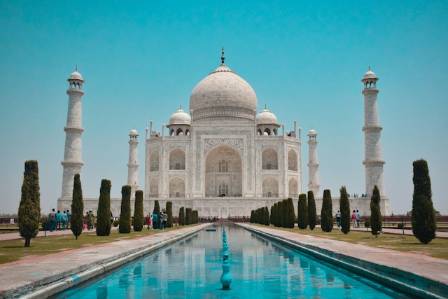
The Taj Mahal is considered one of the finest examples of Mughal architecture, and its design reflects the period’s strong emphasis on symmetry and proportion. The large domed tomb is flanked by minarets, while a central reflecting pool mirrors the main structure.
The surrounding gardens were arranged in four sections as an earthly representation of paradise. Two matching red sandstone structures also contribute to the balance of the complex. A mosque stands on the eastern side, while a guesthouse occupies the western side, creating a carefully coordinated composition.
There is, however, one notable break in this symmetry. Shah Jahan’s cenotaph is positioned slightly to the west of the central axis. This unusual placement disrupts the otherwise precise balance of the interior and has led some people to suggest that Shah Jahan may not originally have intended to be buried within the monument.
The Taj Mahal Occasionally Gets a Facial
Over the centuries, both age and pollution have affected the Taj Mahal’s once brilliant white marble exterior. Exposure to polluted air has caused portions of the surface to develop a yellowish or brownish appearance.
To restore its original brightness, the monument has occasionally received a traditional treatment resembling a facial. A natural clay mixture known as multiani mitti is spread across the marble. The treatment is traditionally used by Indian women to refresh and brighten the skin. After the material is allowed to work on the surface, it is carefully removed with brushes, helping eliminate discoloration and restore some of the marble’s brightness.
Its Appearance Changes Throughout the Day
One of the most captivating qualities of the Taj Mahal is the way its appearance changes as the sun moves across the sky. From early morning through sunset, changing light continually alters the color and character of the marble.
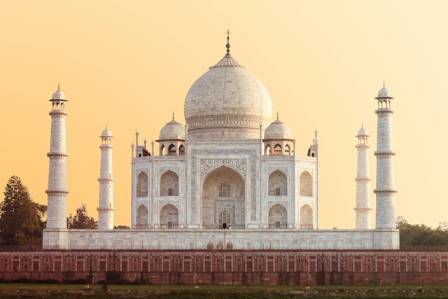
At sunrise, the building may take on soft shades of pale pink or pearly gray. Under the strong midday sun, the marble can appear brilliant white. Around sunset, it may shift toward warm orange and bronze tones. After dark, the monument can take on a cool, almost translucent blue appearance.
Special admission is also available on certain occasions for visitors who want to experience the Taj Mahal under a full moon or during an eclipse.
A Second Taj Mahal Made of Black Marble Was Supposedly Planned
The unusual position of Shah Jahan’s cenotaph has also contributed to another famous local story. According to legend, Shah Jahan intended to build a second Taj Mahal on the opposite side of the Yamuna River. This proposed structure was supposedly designed as a dark mirror image of the existing monument, constructed from black marble, with Shah Jahan eventually buried there.
The story claims that the project was abandoned after Shah Jahan was overthrown by his son, who was also one of Mumtaz Mahal’s children, and subsequently confined at the nearby Agra Fort. However, as with the story about the artisans being mutilated, some historians consider the tale of the black Taj Mahal to be folklore rather than established historical fact.