DIY note
Ten Fascinating Insights Into the Aurora Borealis
In Roman lore, Aurora represented the deity of the first light, while "borealis" originates from the Greek term for wind. Together, "aurora borealis" translates to "dawn wind," though most people today simply call them the Northern Lights. This natural wonder has captivated humanity for millennia and remains a top priority for travelers exploring the Arctic.
Hazel Victoria Dunmore
Maker
Bench tip
Read the full note below and keep tools nearby.
Shelf
Hobby build
In Roman lore, Aurora represented the deity of the first light, while "borealis" originates from the Greek term for wind. Together, "aurora borealis" translates to "dawn wind," though most people today simply call them the Northern Lights. This natural wonder has captivated humanity for millennia and remains a top priority for travelers exploring the Arctic.
Ancient Perceptions of Celestial Fire
For much of human history, the origin of these lights was a complete mystery. Aristotle provided one of the earliest recorded scientific observations in the 4th century BCE, comparing the display to flickering gas flames. By the 13th century, a Norwegian text titled The King's Mirror attempted a more detailed explanation, suggesting the lights were reflections from the world's oceans or perhaps sunlight bouncing from below the horizon. Some even speculated that massive forest fires in Greenland were the source of the glow.
Scientific Breakthroughs in 18th Century Europe
In 1708, Swedish researcher Sun Arnelius proposed that the atmosphere filled with ice particles that reflected solar rays. A particularly vivid aurora over Europe in 1716 accelerated formal research. During this period, Sir Edmund Halley drafted the first comprehensive description of the phenomenon. He was the first to suggest a connection to magnetism, noting that the auroral rays seemed to align perfectly with the Earth's magnetic field.
The Discovery of the Auroral Ring
During the 19th century, Christopher Hansteen coordinated with maritime captains to map the planet's magnetic field. His efforts led him to realize that the aurora wasn't a sporadic event but a consistent ring surrounding the geomagnetic pole. Building on this, Danish scientist Sophus Tromholt established a network of viewing stations, eventually confirming that the lights form a continuous halo around the North Pole.
Magnetism as a Celestial Guide
At the dawn of the 20th century, Norwegian physicist Kristian Birkeland conducted a groundbreaking experiment by firing an electron beam at a magnetized sphere inside a vacuum. He observed the beam being pulled toward the poles by the magnetic force. This led him to conclude that the sun emits beams of particles toward our planet, which are then funneled toward the polar regions by the Earth’s own magnetic field.
The Role of Solar Particles and the Space Age
In the 1930s, Sydney Chapman and Vincent Ferraro suggested that the sun ejects clouds of electrically charged particles into space. Later research clarified that while most of these particles bypass our atmosphere, some are pulled back toward Earth. With the start of the Space Age, satellite technology confirmed that the space surrounding our planet is saturated with high-energy particles and "solar wind" trapped by the magnetosphere.
Velocity and Movement of Solar Flares
We now understand that the Northern Lights result from solar flares—massive releases of matter and radiation caused by gas collisions on the sun's surface. These flares can travel at speeds reaching seven million miles per hour. Depending on the intensity of the solar wind, it takes between one and five days for these particles to reach us. While most particles fly past the Earth, a specific portion enters the atmosphere above the magnetic poles.
Distinguishing Between Soft and Sharp Displays
Most auroral activity occurs within a specific "auroral zone" located 3 to 6 degrees in latitude from the poles. These displays are classified as either diffuse or discrete. Diffuse auroras appear as a soft, featureless glow that can be difficult to see with the naked eye. In contrast, discrete auroras are sharp, well-defined, and can fluctuate wildly in brightness and form.
The Drama of Auroral Breakups
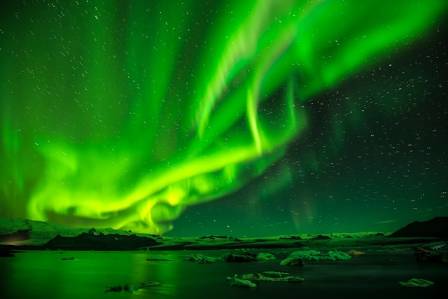
The most sought-after moment for any Arctic traveler is the "auroral breakup." This event marks a sudden intensification where the lights transform from static bands into shimmering, dancing rays that swirl across the sky. On nights with high activity, several breakups can occur. Experts suggest that if you see multiple bands forming early in the evening, a spectacular breakup is likely imminent. These intense bursts of activity can last anywhere from thirty minutes to an hour.
How Gases and Altitudes Create Color
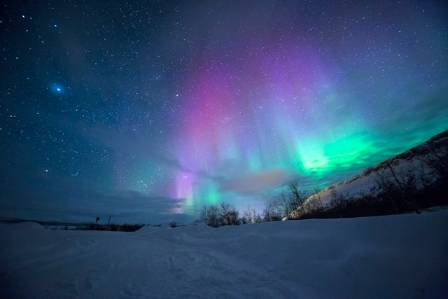
The vibrant palette of the aurora is determined by atmospheric gases and the energy levels of colliding electrons. High-energy electrons hitting oxygen produce green light, while lower-energy collisions result in red. Nitrogen is responsible for pink, violet, and blue hues. Altitude also plays a role: reds typically appear at heights above 105 miles (170 km), greens dominate the middle altitudes, and violets or pinks appear at the lowest levels (50–60 miles).
Tips for Capturing the Perfect Image
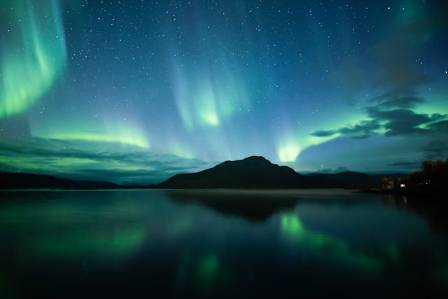
Photographing the Northern Lights requires preparation and patience. It is essential to find a location far from light pollution on a night with clear skies. Many photographers enjoy the presence of a moon to illuminate the foreground, while others seek out still water to capture reflections. A tripod is mandatory due to long exposure times (usually 20–30 seconds), and a wide-angle lens is best for capturing the scale of the sky.
Nearby projects

· en
How to Make a Pixel Art Cat
Ryan Cooper

· en
The Finest Coupes of 2025: Style Meets Substance
Eleanor Vance

· en
15 Amazing Penguin Facts You Need to Know
Elena Rodriguez

· en
The Canary: A Comprehensive Guide to Characteristics and Care
Leonard Felix Harrington

· en
Amazing Facts About Hippos
Maya Rivers

· en
10 Remarkable Health Benefits of Apples
James Whitake